English
 Русский
 Français
 Español
 Tiếng Việt
 한국인
한국인 日本語
日本語 แบบไทยไทย
 Indonesia
 Deutsch
 Português
 عربي
عربي हिन्दी
 Українська
 Türkçe
 Malaysia
 Italiano
Professional·One-stop Services
Get customized solution and favorable quotes here: +8613526692320

Plastic pyrolysis is a process that converts plastic waste into valuable products such as pyrolysis oil, syngas, and carbon black. This technology not only helps in managing plastic waste but also provides a source of alternative energy and industrial raw materials. In this article, we will discuss the input costs, output, and net profit of plastic pyrolysis equipment, using China DOING Company's plastic pyrolysis equipment prices as a reference.

Pyrolysis equipment setting up cost
Investing in a plastic pyrolysis business mainly involves two parts: the purchase of pyrolysis equipment and daily operation. DOING Company offers a variety of pyrolysis equipment configurations to meet different scales of processing needs.
Pyrolysis Equipment Investment:
DOING's pyrolysis equipment series covers a variety of models, from small pilot machines to large industrial production lines.
Batch pyrolysis equipment, ranging from 5 tons to 15 tons, ranges in price from US$40,000 to US$100,000 per unit.
Continuous pyrolysis equipment, ranging in size from 15 to 50 tons per unit, is priced between $300,000 and $500,000.
In addition, we also offer small-scale pyrolysis equipment, such as units with a capacity of 100 kg to 2 tons, priced between $10,000 and $30,000, providing an economical option for small-batch pyrolysis trials or initial investment.
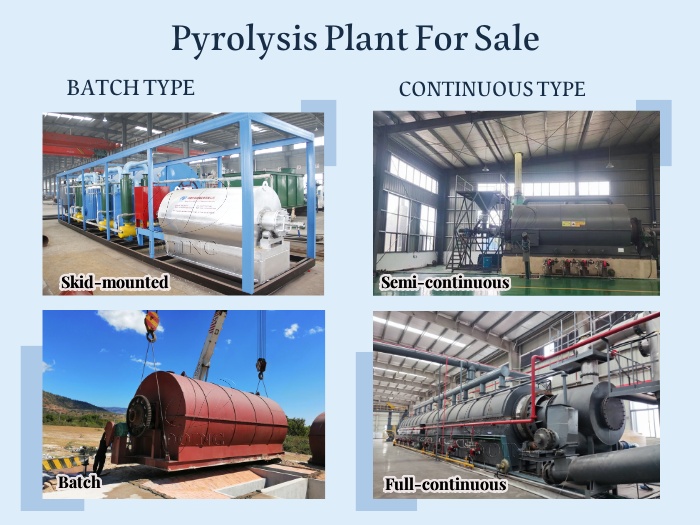
DOING pyrolysis equipment types
These price ranges vary depending on capacity and cost variations resulting from different equipment configurations. You can choose the most suitable pyrolysis equipment model based on your expected throughput and budget.
Operating Costs:
Taking a plastic pyrolysis unit with a daily throughput of 10 tons as an example, we will analyze its daily operating costs in detail. Based on reference data provided by DOING and industry averages:
Raw Material Costs (Waste Plastics):
Assuming the purchase cost of waste plastics is $400/ton, then the raw material cost for processing 10 tons of waste plastics per day is $400. It should be noted that the cost of acquiring waste plastics varies in different regions; some regions can even collect them for free, which will directly increase the project's profitability.
Heating Fuel Costs:
This is a significant expense in the pyrolysis process. DOING offers a variety of heating fuel options to suit different energy supply and cost considerations.
Coal: 0.4 tons * $125/ton = $50
Fuel Oil: 0.4 tons * $490/ton = $196
Diesel: 0.3 tons * $740/ton = $222
Natural Gas: 150 cubic meters * $0.35/cubic meter = $52.5
Pyrolysis Oil and Syngas Produced During Pyrolysis: This option reduces operating costs. By recycling pyrolysis oil or syngas produced during pyrolysis as heating energy, significant savings can be achieved on external fuel purchases.
Electricity Consumption: Assuming the equipment consumes an average of 20 kWh of electricity per day, at a price of $30/20 kWh, the daily electricity cost is approximately $30.
Water Consumption: DOING's pyrolysis equipment is designed with a circulating water tank, allowing for water recycling. Therefore, water consumption is extremely low, almost negligible, reducing water costs.
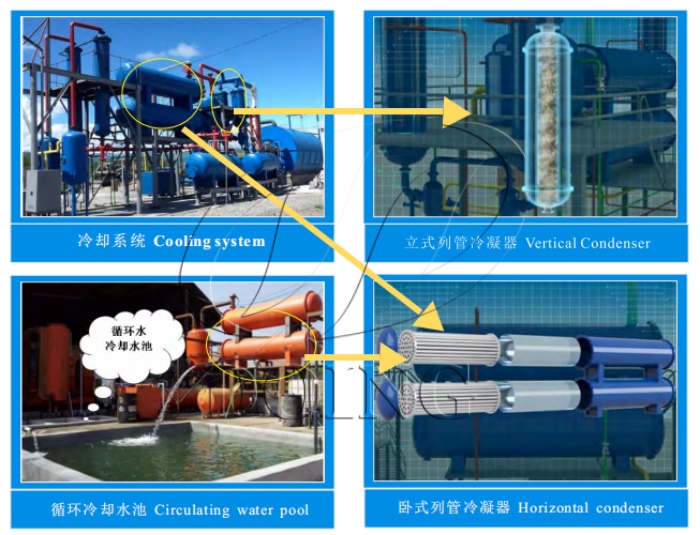
DOING pyrolysis equipment circulating water pool
Labor Costs: The number of operators required varies depending on the specific pyrolysis equipment and project details. Higher levels of automation in the pyrolysis equipment require fewer operators.
The plastic pyrolysis process generates various valuable products, providing diversified revenue streams and improving overall profitability.
Pyrolysis Oil:
Pyrolysis oil is the most important product of plastic pyrolysis, typically accounting for over 40% of the weight of the input plastic. For example, processing 10 tons of plastic per day, with a 40% oil yield, produces 4 tons of pyrolysis oil. Higher plastic purity results in a higher oil yield. Pyrolysis oil can be sold directly or used as an alternative fuel for heating industrial boilers, steel mills, and cement plants. The current average market price for pyrolysis oil is approximately $500 per ton.
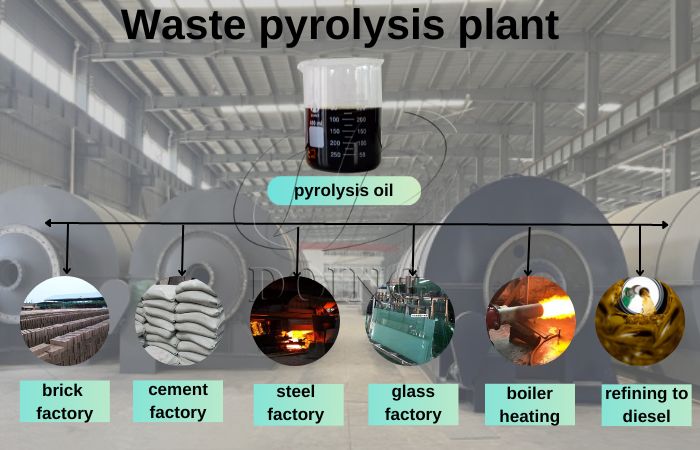
Applications of pyrolysis oil
Carbon Black:
Carbon black is another important solid byproduct of the pyrolysis process, typically accounting for about 30% of the weight of the feed plastic. For example, processing 10 tons of plastic per day can produce 3 tons of carbon black. Carbon black has multiple applications and can be sold directly or processed further to obtain higher added value.
Direct Sales: Taking 3 tons of carbon black as an example, the market price for direct sales is approximately $60/ton, resulting in a profit of 3 tons * $60/ton = $180.
Sales after Further Processing: After grinding, refining, and other further processing, the value of carbon black can be significantly increased, with the price reaching $185/ton. At this point, the sales revenue from 3 tons of carbon black will increase to 3 tons * $185/ton = $555. This provides a significant profit growth point for the project.

Plastic pyrolysis carbon black usages
Other Valuable Outputs:
Synthesis Gas: A certain amount of combustible gas is generated during pyrolysis. This gas can be recovered through pipelines and used directly as heating fuel for the pyrolysis equipment, thereby further reducing or even eliminating the need for external fuel procurement, forming an internal closed loop of energy.
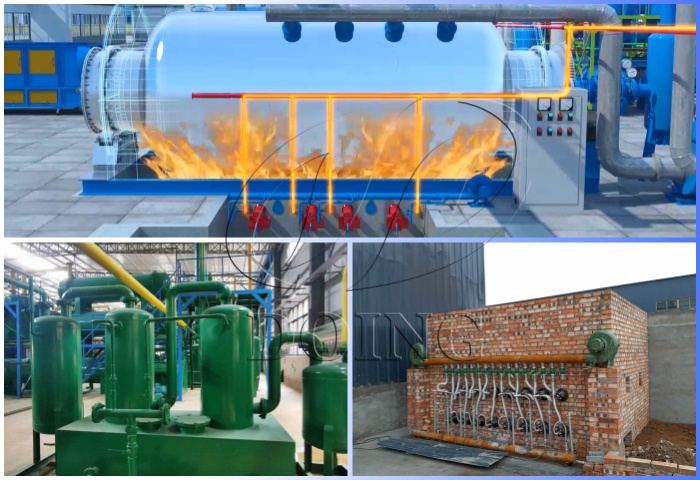
DOING pyrolysis equipment syngas recycling system
Based on the above cost and revenue analysis, we can make a preliminary estimate of the net profit from using DOING's pyrolysis equipment.
Total Revenue (Daily):
Pyrolysis Oil Revenue: $2000
Carbon Black (Direct Sales) Revenue: $180
Total: $2000 + $180 = $2180
Total Costs (Daily):
Raw Material Costs (Waste Plastics): $400
Heating Fuel Costs (Fuel Oil): $196
Electricity Consumption: $30
Labor Costs: $69
Total: $400 + $196 + $30 + $69 = $695
Daily Net Profit:
$2180 (Total Revenue) - $695 (Total Costs) = $1485
The above net profit calculations are based on specific assumptions; actual profits will be affected by various factors.

Profit analysis of DOING plastic pyrolysis equipment
While the plastic pyrolysis business demonstrates significant profit potential, its return on investment is also subject to the following key factors:
Raw material sources and price fluctuations: A stable, low-cost supply of waste plastics is the cornerstone of project success.
Local energy costs: Differences in energy prices across different regions directly impact operating costs.
Product sales channels: Establishing a smooth sales network for pyrolysis oil and carbon black is crucial.

DOING plastic pyrolysis equipment manufacturer
Plastic pyrolysis equipment is not only an environmentally significant investment but also a commercial project with a clear profit model. It effectively solves the plastic waste problem while generating economic benefits. DOING Company possesses extensive industry experience and a professional technical team. We are willing to work with you to provide comprehensive support, from pyrolysis equipment selection and process design to project implementation and post-operation, helping you achieve a win-win situation for both environmental and economic benefits.
contact us
CONTACT US